TDDB (Time-Dependent Dielectric Breakdown) Evaluation System
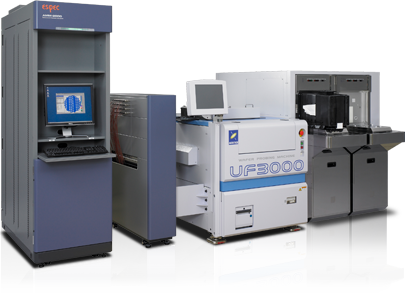
Overview of Equipment
For reliability evaluation of oxide film
Reliability evaluation of oxide film is in demand as an evaluation closely connected with the reliability of LSIs, which continue to become denser and have higher functionality.
This system plays an important role in identifying the cause of a failure due to oxide film characteristics and flattening, and the reduction in resistance of insulation oxide film due to the thinning of the wafer, glass substrate, and package.
Main specifications
Please scroll horizontally to look at table below.
| Voltage/current application range | -50V to +50V / -100mA to +100mA |
|---|---|
| Resolution | 1 mV increments / 1 pA increments |
| Voltage/current measurement range | -50 V to +50 V / -100 mA to +100 mA |
| Number of SMUs | 36 SMU units (up to 324 SMUs) |
Features
- System configuration according to number of measurement
- The TDDB Evaluation System has a SM module per channel to enable voltage and current output and monitoring.
The SM module comprises one board of four SMUs, with a standard configuration (36 SMUs) of units that can house up to 9 boards. It can be expanded up to 9 sets (324 SMUs) on the wafer level.
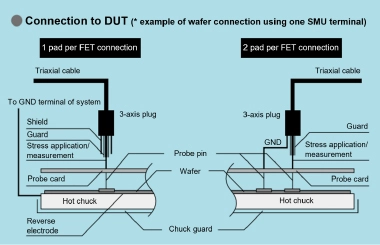
- Connection to DUT
- High accuracy current and voltage application measurement
- The current features a 9 range and a measurement resolution with a maximum current of ±100 mA and a minimum current of ±1 pA. The voltage has a resolution with a maximum voltage of ±50 V and a minimum voltage of ±1 mV, thereby enabling application and measurement with a wide range and high accuracy.
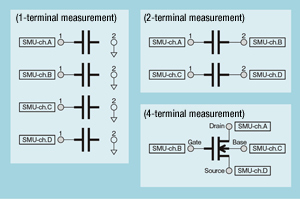
- Measurement terminal connection diagram (TDDB)
- Analytical application software (E-Graph) provided
- You can check the progress status and measurement values of a test in real-time as they update automatically. After measurement, you can create a Weibull plot and measure the life of the specimen using the measurement result. Data can be converted with Excel or other spreadsheet software.
- Supports a wide range of evaluation items
- TDDB evaluation can be performed at the wafer level or glass substrate level.
For example, wetting current can be measured using one SMU terminal between the contact pad (gate) on the wafer surface and the backside (GND), or between two contact pads on the top of the wafer surface (e.g., Gate-GND).
QDB and TZDB evaluations can also be performed by connecting four SMU terminals to the four parts that make up the transistor (Drain, Gate, Base, and Source).
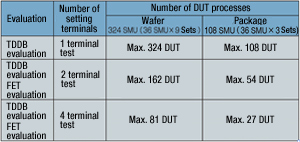
- Number of DUT processes
* The optional software is required to evaluate the FET single unit transistor characteristics.
- Use software to change pin assignments
- Change the terminal settings by cabinet (36 SMUs ×3 sets).
In addition, changes can be made to the pad layout for the same number of terminals on the application for each multi SMU, thereby enabling changes to the pin assignments with the same probe guard.
Recommended products for customers viewing this product
- Contact us
- Customer Support Desk
Measurement & Evaluation Systems / Semiconductor-related Equipment
-
Measurement & Evaluation Systems
- Electro-chemical Migration Evaluation System(Leakage Current Evaluation System)
- High Voltage Bias Insulation Resistance Evaluation System
- Capacitor Leakage Test System
- High Temperature Reverse Bias Test System
- TDDB (Time-Dependent Dielectric Breakdown) Evaluation System
- Conductor Resistance Evaluation System
- Electromigration Evaluation System
- PV Thermal-Bias Combo Test System
- Semiconductor Parametric Test System
- Capacitor / Inductor Temperature Characteristic Evaluation System
- PV I-V Evaluation System (PV Thermal-Light Combo Test System)
- Power Cycle Test System
- Semiconductor-related Equipment