
ESPEC Quality is more than a word

MENU

Materiality (important issues)

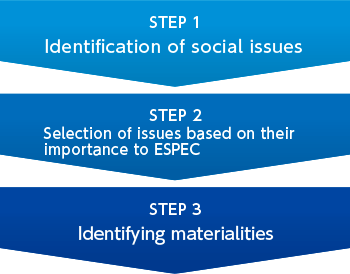
Process for identifying materialities

To achieve sustainable medium- to long-term value creation together with society, ESPEC identifies and prioritizes key material issues (“materiality”).
When identifying materialities (important issues), we first referred to GRI standards, SDGs (Sustainable Development Goals), external investigations, and other materials, and identified the social issues. Next from the identified issues, we selected the issues which we will address in order to achieve continuing growth from the perspective of consistency with THE ESPEC MIND and our long-term vision. The selected issues were discussed and decided by the executive Committee in order to identify ESPEC materialities. With respect to materialities, we will make flexible revisions as suitable to changes in society.
■ FY 2024 Materiality
KPI Targets & Results

Please scroll horizontally to look at table below.

Materialities KPI Targets KPI Results
Solve social challenges through global business
  • Expanding sales of products and services in advanced technology fields
  • Strengthen Technology Development Capability
  • Increased sales of products and services, mainly in advanced technology fields
    Consolidated Net Sales: 65 billion yen
  • Consolidated net sales: 67.2 billion yen (up 8.3% year on year)
  • Expanded product lineup for advanced technology fields, including rapid-rate thermal cycle chambers
  • Launched ECO-type low-temperature constant (and constant humidity) chambers with significantly reduced power consumption
  • Group company launched rapid temperature change chambers equipped with low-GWP refrigerant R-473A
  • Opened the “Aichi xEV Battery Safety Test & Certification Center” and expanded the functions of the Toyota Test Center under the “Aichi Next-Generation Mobility Test Lab” initiative
  • Strengthening global marketing
  • Improvement of regional sales makeup with consideration of geopolitical risk
  • Net sales increased mainly in Japan and the U.S.
  • Overseas sales ratio: 51.9% (down 1.2 percentage points year on year)
  • Breakdown of Net Sales by Region
    Japan: 48.1% (up 1.2 points year on year)
    North America: 16.6% (up 1.3 points year on year)
    Europe: 4.3% (down 1.2 points year on year)
    China: 17.4% (down 2.2 points year on year)
    Taiwan: 1.7% (±0 points year on year)
    South Korea: 4.4% (up 0.2 points year on year)
    Southeast Asia and India: 5.9% (up 0.5 points year on year)
    Others: 1.6% (up 0.3 points year on year)
  • Creation and expansion of new businesses that contribute to solutions for social issues
  • Creation and cultivation of new business
  • Launched thermal deformation measurement and thermal image analysis services related to CAE (Computer Aided Engineering)
  • Released the “Ultra-Low Temperature Shock Freezer,” which enables freezing while maintaining the freshness of perishable foods
Provide products and services with responsibility
  • Strengthening the global supply chain (stable procurement)
  • Sustainable procurement
  • Establishment of a supply chain that considers geopolitical risk and sustainable procurement
  • Optimization of inventory assets
  • Launched and began activities under the Procurement Project
  • Reduced inventory through initiatives for optimization of inventory assets year on year
  • Utilizing technologies (IT, AI)
  • Strengthening our core plants (production functions) and enacting manufacturing innovations
  • Expansion of domestic production capacity
  • Increased domestic production capacity by 1.3 times year on year
  • Increasing customer satisfaction
  • Providing new products and services that serve customer needs
  • Expansion of preventive maintenance services (network services)
  • Global deployment of QMS (Quality Management System)
  • Expanded product lineup for advanced technology fields, including rapid-rate thermal cycle chambers
  • Launched ECO-type low-temperature constant (and constant humidity) chambers with significantly reduced power consumption
  • Group company launched rapid temperature change chambers equipped with low-GWP refrigerant R-473A
  • Opened the “Aichi Battery Safety Testing Center” and expanded the functions of the Toyota Test Center under the “Aichi Next-Generation Mobility Test Lab” initiative
  • Achieved sales targets for preventive maintenance (network) services
  • Deployed the Quality Standards Manual to Group companies
Be environmentally friendly
  • Measures to Combat Global Warming
  • Conserving Biodiversity
Securing and Cultivating Diverse Human Resources
  • Creating work satisfaction and improving engagement
  • Enhancing support systems in skill development
  • Updating management style, 1on1 meetings
  • Reforms to the human resource evaluation system
  • Implementation of engagement surveys; improvements to overall results compared to last fiscal year
  • Held companywide event “Progressive Plus”
  • Conducted a “Round-Up Training Course” to promote the dissemination of the corporate philosophy
    Participants: 375
  • Conducted managerial position renewal assessments and promoted 1-on-1 meetings
  • Formulated a new human resource evaluation system (introduced in April 2025)
  • Conducted engagement surveys
    Improvements to overall results compared to last fiscal year
  • Providing employees with opportunities to grow and shine
  • Providing employees with opportunities to grow and shine
  • Training of the next generation of upper management; holding Junior Board meetings
  • Securing and training global personnel and DX personnel
  • Conducted career training by age group
  • Completed Junior Board program
  • Implemented overseas training system “Global Trainee Program”
  • Promoted acquisition of IT Passport and similar certifications for managers
  • Diversity & Inclusion
    (women, seniors, foreign nationals, people with disabilities, LGBTQ)
  • Training women for management positions
  • Percentage of female managers: 10% or more
  • Promoting disability hires
  • Rate of disability hires: 2.5% or more
  • Percentage of female managers: 9.8% (as of April 1, 2025)
  • Received the Platinum “Kurumin” Certification from the Ministry of Health, Labour and Welfare
  • Received top-tier “Three-Star” and “Ikumen Promotion Company” certifications under the Leading Company in Women’s Advancement in Osaka City
  • Employment rate of persons with disabilities: 2.46% (as of March 31, 2025)
  • Respect for human rights, ensuring employee health and safety
  • Implementation of harassment education: 1 or more times
  • Promotion of initiatives to reduce workloads
  • Establishing companywide policies for health management
  • Conducted harassment prevention training for managers
    Two sessions held
  • Introduced labor-saving equipment at domestic production sites
  • Annual paid leave utilization rate: 77.8% (74.3% in the previous year)
  • Set “Promotion of Health and Productivity Management” in the FY2025 Management Plan
Enhancement of Group Governance
  • Fair and Transparent Management
    (Corporate Governance / Compliance)
  • Full compliance with the Corporate Governance Code
  • Thorough permeation of the Code of Conduct and Behavior Guidelines in the group both domestically and internationally
  • Full compliance with the Corporate Governance Code
  • Conducted education on the Code of Conduct and Behavior Guidelines at domestic and overseas Group companies

■ FY 2025 Materiality KPI Targets
* Partial revision of materiality implemented from FY2025

As of October, 2025

Please scroll horizontally to look at table below.

Materialities Risks and Opportunities KPI Targets
Solve social challenges through global business
  • Expanding sales of products and services in advanced technology fields
  • Strengthen Technology Development Capability
[Risks]
  • Declining predominance and sales for our products
  • Obsolete business models due to the arrival of new technologies
[Opportunities]
  • Increasing predominance for our products in advanced technology fields
  • Capturing new markets through new Environmental Creation Technology
  • Increased earnings from products and services focused on advanced technology fields
    (Consolidated) Net Sales ¥68.0 billion
    Operating Profit ¥8.5 billion
    Operating Profit Ratio 12.5%
  • Strengthening global marketing
[Risks]
  • Impact on profits due to global political and economic anxiety
[Opportunities]
  • Global profit growth and stable profits
  • Establish competitive advantages in global markets by leveraging the Group’s collective strengths
  • Creation and expansion of new businesses that contribute to solutions for social issues
[Risks]
  • Stunted growth due to reliance on existing businesses
  • Declining stakeholder assessments
[Opportunities]
  • Securing new sources of profit
  • Improving stakeholder assessments
  • Develop new products and services in the thermal solutions and food machinery businesses
Provide products and services with responsibility
  • Strengthening the global supply chain (stable procurement)
  • Sustainable procurement
[Risks]
  • Impact on procurement and profits due to global political and economic anxiety
  • Declining product sales due to inability to adapt to regulations in each country
  • Human rights violations in the supply chain
[Opportunities]
  • Achieving stable procurement
  • Enhanced product competitiveness through compliance with regulations in each country
  • Implement Business Continuity Plan (BCP) for critical components
  • Utilizing technologies (IT, AI)
  • Strengthening our core plants (production functions) and enacting manufacturing innovations
[Risks]
  • Losing opportunities due to prolonged lead times
  • Variations in product quality and declining product predominance
[Opportunities]
  • Expanding manufacturing capabilities, standardizing product quality, shortening lead times, and improving product predominance
  • Improving labor productivity through the use of IT and AI
  • Introduce systems and equipment to promote automation and labor savings in production
  • Shorten production lead times
  • Increasing customer satisfaction
[Risks]
  • Declining predominance and profits for our products
  • Declining points of contact with customers in advanced technology fields
[Opportunities]
  • Increasing predominance for our products through differentiation with competitors
  • Capturing customers’ needs in advanced technology fields
  • Provide new products and services that serve customer needs
  • Expand preventive maintenance services using network technologies
  • Reduce product defect rates in the market
Be environmentally friendly
  • Measures to Combat Global Warming
[Risks]
  • Declining product sales due to inability to adapt to environmental regulations
  • Higher energy costs
[Opportunities]
  • Expansion of the propagation of products and services with enhanced environmental performance
  • Increase in sales for the environmental preservation business and plant cultivation equipment business
  • Conserving Biodiversity
[Risks]
  • Declining social assessments
[Opportunities]
  • Increasing sales in the environmental preservation business and biodiversity business
  • Improving social assessments
Securing and Cultivating Diverse Human Resources
  • Creating work satisfaction and improving engagement
[Risks]
  • Worsening of corporate culture
  • Declining labor productivity and outflows of personnel
[Opportunities]
  • Improved vitality in the organization, labor productivity, and motivation
  • Announce and promote long-term vision “ESPEC Vision 2035”
  • Introduce and operate a new vision-driven personnel evaluation system
  • Conduct “Round-Up Training Course” (to promote understanding of the corporate philosophy and vision), including domestic and overseas Group companies
  • Promote 1-on-1 meetings
  • Conduct one engagement survey
    Employee engagement improved year on year
  • Introduced the Trust-type Employee Shareholding Incentive Plan (E-Ship®)
  • Providing employees with opportunities to grow and shine
[Risks]
  • Declining adaptability to change due to obsolete personnel skills and a shortage of specialized expertise
  • Declining capacity of the company to maintain sustained growth
[Opportunities]
  • Further growth driven by highly capable personnel
  • Continuous training of core personnel
  • Formulated talent development plans for each division
  • Training of next-generation management
    University degree qualification course:
    2 participants completed
  • Implemented overseas training system “Global Trainee Program”
  • Diversity & Inclusion
    (women, seniors, foreign nationals, people with disabilities, LGBTQ)
[Risks]
  • Declining capacity for innovation due to personnel characteristics and skill imbalances
  • Declining social assessments due to slow response
[Opportunities]
  • Innovation from creative organizations
  • Improving social assessments
  • Training women for management positions
    Percentage of female managers: 15% or more (at April 2026)
  • Promote and stabilize employment of persons with disabilities
    Employment rate of persons with disabilities: 3%
  • Ensuring employee health and safety
[Risks]
  • Declining labor productivity and outflows of personnel due to poor physical health
[Opportunities]
  • Improving labor productivity and securing excellent personnel
  • Formulate policies for health management
Respect for Human Rights
  • Respect for human rights throughout all corporate activities
[Risks]
  • Loss of social credibility and employee turnover
[Opportunities]
  • Securing social credibility
  • Formulate human rights policy
  • Conduct harassment prevention training (for all employees and managers)
    2 sessions
  • Conduct companywide harassment survey
    1 time
Use of Digital Technologies
  • Use of digital technologies throughout all corporate activities
[Risks]
  • Insufficient development of digital personnel
  • Declining labor productivity
[Opportunities]
  • Development of digital personnel
  • Labor-saving and productivity improvement through automation
  • Introduce and operate new cloud storage services
Enhancement of Group Governance
  • Fair and Transparent Management
    (Corporate Governance / Compliance)
  • Enhancement of information security
[Risks]
  • Loss of social credibility, declining corporate value
[Opportunities]
  • Securing transparency in decision-making and sustained growth
  • Securing stakeholder trust
  • Formulate “ESPEC Vision 2035” to clarify our desired position ten years from now
  • Conduct education on the corporate philosophy, Code of Conduct and Behavior Guidelines at domestic and overseas Group companies
  • Rebuild BCP (Business Continuity Plan)
  • Establish internal control systems and strengthen information security across domestic and overseas Group companies